Google Ads vs. Facebook Ads: Which Is Best for Small Businesses
Do you know that 40-70% of small businesses rely on paid advertising (either Google or Facebook ads) to generate traffic? Digital advertising is crucial for small businesses because it provides access to paid media tools, enables precise audience targeting, and offers real-time tracking to help them compete with large brands.
Google Ads and Facebook Ads (also known as Meta Ads) are primary digital advertising platforms that small business owners use to drive traffic to their social media handles, landing pages, or websites. For small businesses, every single penny counts like a million dollars, making it essential to choose the right digital advertising platform to reach the right audience, generate qualified leads, and maximise your return on investment (ROI).
If you are a small business owner and confused about whether you should select Google Ads or Facebook Ads to meet your business goal, this article is for you. Here, you will get comprehensive details about which performance marketing platform is ideal for a small business like yours.
What are Google Ads?
Google Ads is Google’s pay-per-click (PPC) advertising platform that allows businesses to promote their products and services across Google Search, YouTube, Gmail, Google Maps, Google Shopping, Discover, and millions of websites in the Google Display Network. Unlike traditional advertising, Google Ads helps businesses reach people who are actively searching for products or services, making it one of the most effective platforms for generating high-quality leads and conversions.
For example, if someone searches for “best bakery near me” or “affordable digital marketing agency,” Google displays relevant paid advertisements above the organic search results. Businesses only pay when users click on their ads (for most campaign types), making Google Ads a cost-effective solution for businesses looking to drive measurable results.
How Do Google Ads Work?
Google Ads works through an auction-based system. When a user enters a search query, Google identifies ads relevant to the keyword and determines which ones should appear based on several factors, including:
- Maximum bid amount
- Ad Quality Score
- Expected click-through rate (CTR)
- Ad relevance
- Landing page experience
The advertiser with the highest combination of bid and ad quality doesn’t always win. Google prioritizes relevant, high-quality ads to provide users with the best possible experience.
Types of Google Ads Campaigns
- Search Ads
Search Ads are text-based advertisements that appear at the top of Google’s search engine results pages (SERPs). These ads target users with high purchase intent because they are actively searching for a solution.
Best for:
- Local businesses
- Service providers
- Lead generation
- Appointment bookings
- Display Ads
Display Ads are visual banner advertisements that appear on websites, mobile applications, and blogs within Google’s Display Network. They help businesses increase brand visibility and reconnect with previous website visitors through remarketing.
Best for:
- Brand awareness
- Remarketing
- Product promotions
- Audience expansion
- Shopping Ads
Shopping Ads showcase product images, prices, ratings, and store information directly in Google Search. They are specifically designed for e-commerce businesses and online retailers.
Best for:
- Online stores
- Fashion brands
- Electronics
- Consumer products
- Video Ads
Video Ads appear on YouTube before, during, or after videos, and sometimes across Google’s partner websites. They help businesses engage audiences through storytelling and product demonstrations.
Best for:
- Brand awareness
- Product launches
- Tutorials
- Customer engagement
- Performance Max Campaigns
Performance Max is Google’s AI-powered campaign type that automatically displays ads across all Google channels, including Search, Display, YouTube, Gmail, Discover, Maps, and Shopping. Machine learning optimizes bidding, targeting, and placements to maximize conversions.
Best for:
- Businesses with multiple marketing goals
- E-commerce brands
- Businesses looking for automated optimization
What Are Facebook Ads (Meta Ads)?
Facebook Ads, now managed through the Meta Ads platform, allow businesses to advertise across Facebook, Instagram, Messenger, and the Meta Audience Network. Unlike Google Ads, which targets users based on search intent, Facebook Ads target users based on their interests, demographics, behaviors, and online activities.
This makes Facebook Ads an excellent choice for creating brand awareness, reaching new audiences, and nurturing potential customers who may not yet be actively searching for your product or service.
How Do Facebook Ads Work?
Facebook Ads use audience-based targeting rather than keyword targeting. Businesses can create highly specific audience segments using factors such as:
- Age
- Gender
- Location
- Interests
- Behaviors
- Job titles
- Education
- Income levels
- Website visitors
- Customer lists
- Lookalike audiences
Ads appear in users’ Facebook and Instagram feeds, Stories, Reels, Marketplace, Messenger, and other placements. Meta’s AI also optimizes ad delivery by showing advertisements to users most likely to take the desired action, such as clicking a link, filling out a lead form, or making a purchase.
Types of Facebook Ads
- Image Ads
- Video Ads
- Carousel Ads
- Collection Ads
- Instant Experience Ads
- Lead Generation Ads
- Stories Ads
- Reels Ads
Google Ads for Lead Generation: Pros and Cons
Pros
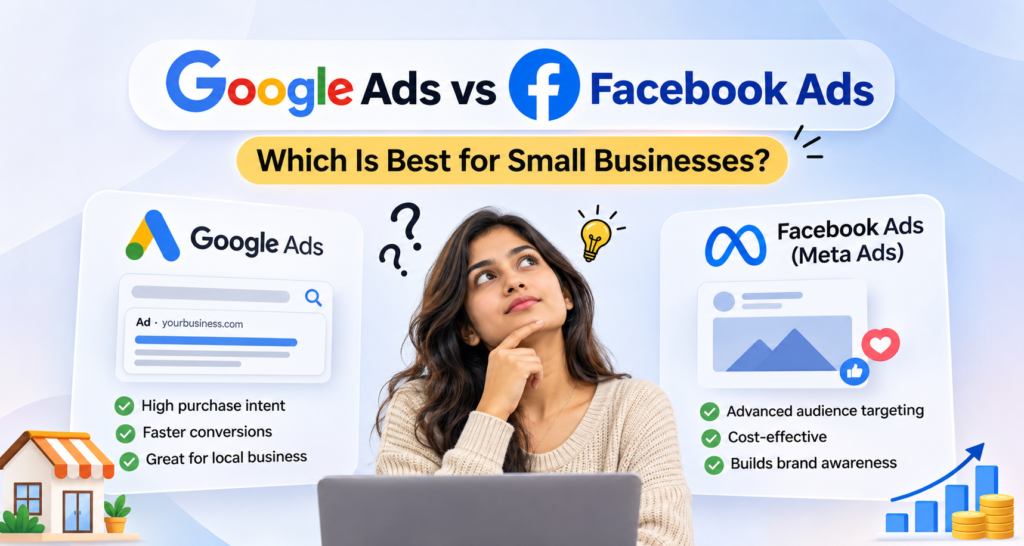
- Reaches users with high purchase intent.
- Delivers faster conversions for products and services.
- Offers measurable ROI.
- Flexible budgeting for businesses of all sizes.
- Effective for local businesses and emergency services.
Cons
- Competitive industries often have higher cost-per-click.
- Requires ongoing keyword research and optimization.
- Poorly optimized campaigns can become expensive.
Facebook Ads for Lead Generation: Pros and Cons
Pros
- Advanced audience targeting.
- Lower advertising costs in many industries.
- Excellent for building brand awareness.
- Supports highly engaging visual content.
- Powerful remarketing capabilities.
Cons
- Lower purchase intent than Google Ads.
- Creative fatigue requires regular updates.
- May take longer to generate direct sales.
Cost Comparison: Google Ads vs Facebook Ads
Although advertising costs vary depending on the industry, competition, and targeting options, Google Ads for lead generation generally has a higher average cost-per-click because businesses compete for high-intent keywords. However, these clicks often lead to higher conversion rates.
Facebook Ads for lead generation typically offer a lower cost per click and lower cost per thousand impressions (CPM), making them an attractive option for businesses with smaller advertising budgets that want to build awareness or engage potential customers.
If your goal is immediate lead generation or sales, paying a higher CPC on Google Ads may deliver a better return on investment. If your objective is to increase brand visibility or grow your audience, Facebook Ads can provide more value for your budget.
Which Platform Is Better for Small Businesses?
The answer depends entirely on your business goals.
Choose Google Ads if you want to:
- Generate qualified leads quickly.
- Capture customers actively searching for your products or services.
- Increase website conversions.
- Promote local services.
- Drive phone calls or appointment bookings.
Choose Facebook Ads if you want to:
- Increase brand awareness.
- Build an engaged community.
- Reach new audiences based on interests.
- Promote visually appealing products.
- Retarget previous website visitors.
Use Both Platforms if you want to:
- Build a complete marketing funnel.
- Increase brand awareness through Facebook Ads.
- Retarget interested users.
- Capture high-intent buyers with Google Ads.
- Maximize your overall ROI.
Final Verdict
There is no one-size-fits-all answer to the Google Ads vs Facebook Ads debate. Both platforms offer unique advantages, and the right choice depends on your business objectives, target audience, and budget.
If your goal is to capture customers with immediate buying intent and generate leads quickly, Google Ads for lead generation is often the better choice. On the other hand, if you want to build brand awareness, engage potential customers, and create demand through visually appealing content, Facebook Ads for lead generation is an excellent option.
For many small businesses, the most effective strategy is to use both platforms together. Facebook Ads can introduce your brand to new audiences, while Google Ads can convert interested prospects who are actively searching for your products or services. By combining the strengths of both platforms, small businesses can build a well-rounded digital marketing strategy that drives sustainable growth and maximizes return on investment.